























Sakorn Sukkasemsakorn via istockphoto
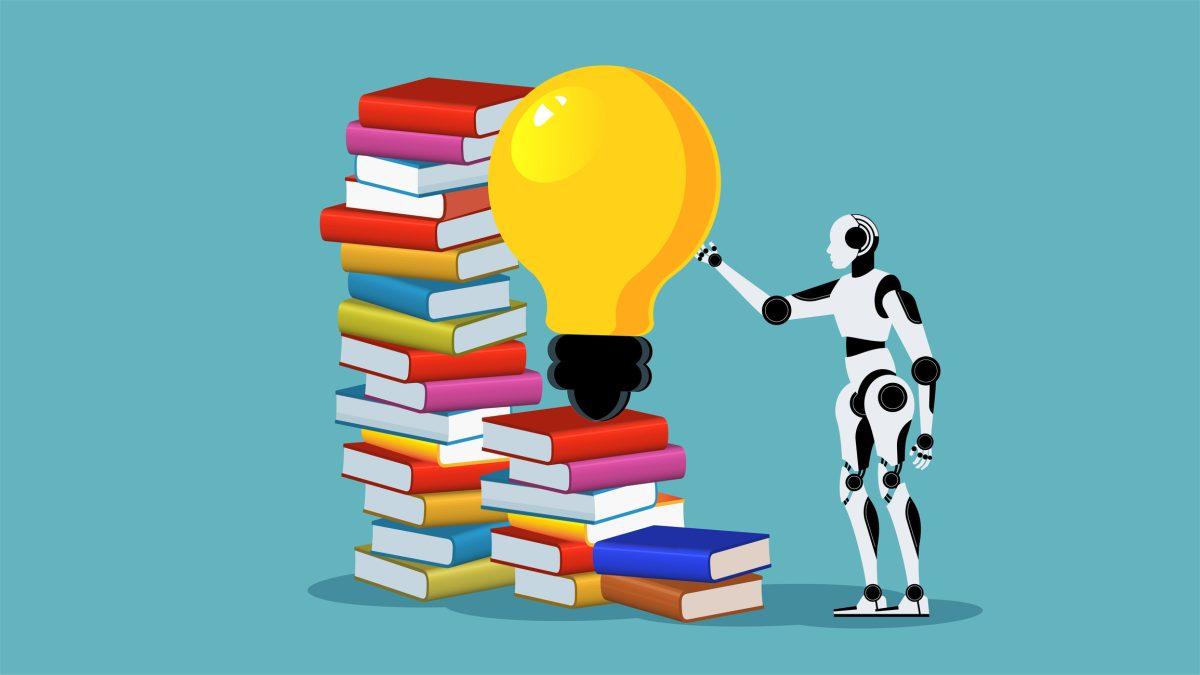
Without a doubt, AI is one of the most common tools students turn to when brainstorming for an assignment or learning a concept. While this habit may seem harmless and a utilization of new resources, this tendency poses many questions for the innovation process. Now that AI can generate creative ideas with a one-sentence prompt given by a human, the US Patent and Trademark Office (USPTO) must address to what extent AI can be used, and, whether it can be considered an inventor. While this question is at the forefront of organizations like the USPTO, it should also be top of mind for students as they learn to properly balance AI with their own ideas as they innovate on campus, and, eventually, through their careers.
What are patents and how do they get issued?
In the words of the USPTO, in order for an invention to be patentable, it must be “novel and non-obvious.” A patent agent determines whether a product fits these qualifications when they do due diligence, which is the process of searching prior issued US and foreign patents to ensure that the invention in question is truly unique. Once it has been determined that an item can be patented, it is sent to the USPTO.
Once the patent application is submitted, the process is lengthy and requires significant amounts of back-and-forth because patents are groundbreaking for inventors and business owners. By granting patent holders a monopoly over their product for 20 years, even once the patent expires, patent holders have a major competitive advantage for years to come.
In addition to being a very long process, a requirement for issuing a patent that is often overlooked is that inventor must be human, which is a precedent that was explicitly set forth through the case Thaler v. Vidal (2022). With the evolution of AI, this requirement has proven to be nuanced, given continual use of AI in everyday life. Today, it is uncommon to go through a brainstorming and execution process without involving AI in some way. Therefore, it is unclear how inventors can balance the requirement of inventors being human with the presence of AI in innovative processes today.
How does AI affect patents?
In Thaler v. Vidal, Dr. Steven Thaler created an AI software called the Autonomous Bootstrapping of the Unified Sentience (DABUS). He used this software to generate inventions, for which he later filed patents. However, the patents for the inventions that DABUS created were rejected on the basis that the Patent Act states that inventors are “the individual or… individuals collectively who invented.” As one could imagine, this terminology created difficulty, given the question of whether AI can be considered an “individual.” The USPTO justified its rejection of these patent applications, citing that the Supreme Court had previously ruled that an “individual” is synonymous with “human being” unless explicitly stated otherwise. Therefore, AI was not considered a valid inventor.
However, this case is just the beginning of the evolution of the role that AI plays in the invention process. According to a report by the University of Maryland, Baltimore, AI can be used in the invention process as long as a human was a “significant” part of the design process. While this seems to provide some clarity on the surface, this conclusion only creates more questions. Namely:
- How is “significant” contribution defined? Who decides its definition?
- How can the USPTO verify the degree to which a human contributed to the invention process?
- Are there restrictions as to what kind of AI can be used?
- Are there restrictions as to when AI can be used? Can AI be used to assist in the brainstorming process? Can it be used in the production process? The design process?
Evidently, there are many questions yet to be answered regarding the role of AI in invention. As Vanderbilt is home to many future and current inventors, I turned to the Wond’ry, Vanderbilt’s makerspace, to gain perspective on this issue.
How does the Wond’ry encourage creativity in light of AI?
In an interview with Dr. Kevin Galloway, the Executive Director of the Wond’ry and Research Associate Professor of Mechanical Engineering, he highlighted the Wond’ry’s commitment to embracing student creativity and thinking in light of the presence of AI.
Dr. Galloway shed light on Vanderbilt’s Innovation and Design Strategy minor, which is comprised of classes taught at the Wond’ry, in which “learners first develop core innovation frameworks such as problem definition, ideation, clustering, and synthesis using their own reasoning. Once they understand the mechanics of idea generation and evaluation, we introduce AI as a collaborative tool that can help accelerate aspects of the innovation.” Specifically, he stated that AI can help with processes such as:
- Expanding idea variations
- Reframing problem statements
- Stress-testing assumptions
- Generating rapid concept sketches
- Supporting early-stage prototyping
Even though AI can certainly increase efficiency, Dr. Galloway emphasized the fact that AI should not be used to blindly generate ideas or content. In fact, it must be “edited, challenged, and refined through the learner’s own judgement and domain knowledge.” Using this framework to navigate the usage of AI, students at Vanderbilt can ensure that their ideas are truly their own, unique, and creative as opposed to simply the work of AI.
Dr. Galloway highlighted the fact that the Wond’ry is committed to educating students about process literacy in conjunction with good practices for using AI. In his words, “process literacy means understanding how ideas are generated, evaluated, and refined.” While AI can certainly generate ideas, it is crucial to understand that, for items to be patentable, they must be a human’s idea. Therefore, it is important for students utilizing AI to ensure their final products are their own ideas, created with the assistance of AI as opposed to AI’s ideas slightly edited and being framed as their own.
What resources are there for students interested in innovating?
In addition to participating in the Innovation and Design Strategy Minor, students at Vanderbilt interested in innovation can take advantage of the many resources that the Wond’ry has to offer. Specifically, Dr. Galloway stated that the Wond’ry has a prototyping studio where students can gain “access to tools, equipment, and expert technical support for building and testing ideas.” In addition, the Wond’ry hosts programs such as IMPACT (Innovation, Market-Driven Productization, and Commercialization of [deep] Technologies) where students can receive “mentorship and guidance from concept through validation.”
If students have successfully produced a novel technology or idea that could be patented, Dr. Galloway directs them to the Center for Technology Transfer and Commercialization (CTTC). However, if students are ever unsure of where to go or who to speak to, he emphasized that they can reach out to the Wond’ry and they will be directed from there.
What does this mean?
Naturally, many questions arise regarding innovation in the presence of AI. Given that court proceedings that could provide more guidance regarding this matter take significant amounts of time, definite answers regarding what qualifies as “too much” AI usage in the innovation process are unlikely anytime soon. In addition, considering AI’s rapid evolution, when decisions are finally made, it is probable that questions will linger.
However, Vanderbilt students are fortunate to have access to resources like the CTTC and the Wond’ry, which can provide them with guidance during the innovation and creative process, whether they are working on a project for a class, or exploring and innovating independently.
AI is here to stay, and one of the most important skills Vanderbilt students can learn is how to leverage it.
_________________________________________________
Interested in learning more about IP and its intersection with AI? Check out the rest of Sasha Eckler’s Spotlight Series: